

History of Bariatric Surgery

(commonly referred to by Weight Loss Surgery, Stomach Stapling)

Understanding the History of Weight Loss Surgery and what procedures have been tried and which have failed and why we think they failed is a key to making an informed choice. Every Bariatric Weight Loss Surgery has advantages and disadvantages, successes and failures, so familiarize yourself with the history of bariatric surgery and ask questions of your surgeon.

More History of Weight Loss Surgery Information


Introduction to Weight Loss Surgery

A compelling article by Dr. Champion covering the “Introduction to Weight Loss Surgeries“, The “Disease of Morbid Obesity” and answering the  most important pre-op questions of  “Why Weight Loss Surgery works, even when the patients have previously failed so many diets?” and “What are the keys to Weight Loss Surgery?”

If you are researching Bariatric Surgery this Introduction to Weight Loss Surgery covers the fundamentals.

More on the Introduction to Weight Loss Surgery


Weight Loss Procedure call Gastric Bypass, Roux-en Y, RUNY, RNY

Bariatric Roux-en Y Gastric Bypass Procedure

(This procedure is commonly referred to as Gastric Bypass, Roux -en-Y, RUNY, RNY or Proximal Bypass)

This surgery was the first Bariatric procedure, performed in 1993, called the Roux-en-Y (Gastric Bypass surgery). The Gastric Bypass Roux-en Y procedures, have become the most commonly performed procedure in weight loss surgery history. The Gastric Bypass procedure achieves weight loss by restricting caloric & nutrient intake by reducing stomach capacity and re-routing the intestinal tract.

More Roux-en-Y Information


Get the Flash Player to view DrChampion’s Video on Bariatric Surgeries and Procedures for weight loss treatments for sever morbid obesity.


Bariatric Procedure for weight loss surgery called Vertical Banded Gastropasty aka Stomach Stapling

The Vertical Banded Gastroplasty

(This procedure is commonly referred to as VBG, Stomach Stapling and Laparoscopic VBG and the Lap/VBG)

Vertical Banded Gastroplasty is also commonly referred to as “Stomach Stapling” This procedure utilizes both a band and staples to create a smaller stomach pouch. The Vertical Banded Gastroplasty (VBG & Laparoscopic VBG) limits food intake by creating a small pouch (1/2 ounce) in the upper stomach with a narrow outlet (1/2 inch) reinforced by a mesh band to prevent stretching. The pouch fills quickly and empties slowly with solid food, producing a feeling of fullness. Over eating results in pain or vomiting. This restricts food intake. This is the simpler procedure surgically then the Roux-en Y Gastric Bypass, with a generally lower risk of complication’s and shorter hospital stay.

More Vertical Banded Gastroplasty Information >


Types of Adjustable Gastric Bands

(Commonly called Restrictive Weight Loss Surgeries, Laparoscopic Adjustable Gastric Bands)

The Laparoscopic Adjustable Gastric Bands (LAGB) are designed to induce weight
loss by restricting food consumption. The bariatric patient will eat less volume of food and fill up quickly, if you make the right food choices, and that results in reduced calories. The addition of exercise increases calories burned and further enhances weight loss. If you overeat you throw up. The two types of Adjustable Gastric Bands bands (Lap Band© manufactured by Allergan and Realize Band© manufactured by Ethicon) which are currently approved by the FDA

More information of the Types of Adjustable Gastric Bands


Image of the Lap Band surgery for Weight Loss in obese patients

The LAP-BAND

(commonly referred to as the Adjustable Laparoscopic Band, Gastric Banding and Adjustable LapBand)

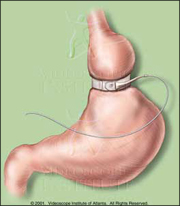
The Adjustable LAP-BAND is a surgical procedure in which an adjustable and reversible elasticized belt is wrapped around the upper portion of the bariatric patient’s stomach. The
LAP BAND constricts the stomach, allowing the patient to quench their hunger much more rapidly than ever before. The device is connected to a port providing for easy adjustment over time, giving way for the potential for more weight to be lost.

The LAP-BAND is designed to induce weight loss by restricting food consumption, and is a variation of the Vertical Banded Gastroplasty (VBG).

An adjustable elastic band is placed around the upper stomach to create a small 15cc (one half ounce) pouch with a narrowed outlet. The outlet size can be adjusted by injecting saline into a small reservoir (port) placed under the skin at the time of surgery, and connected to the band by an I.V. tubing. The pouch fills quickly with solid food and empties slowly to relieve hunger and produce a feeling of fullness. Overeating results in pain or vomiting to limit food intake.
More Lap Band Information >


REALIZE® Band

(commonly referred to as REALIZEBand, Realize Gastric Band, REALBand and simply REALIZE®)

The REALIZE Gastric Band is the second type of adjustable gastric bands that was approved by the FDA in 2007. Realize Band is similar to the Adjustable LAP-Band and that it is adjustable and reversible; made up of silicone, and has a balloon attached that fits around the perimeter of the stomach. This balloon is filled with saline which serves to contain the expansion of the stomach over time. The Realize Band dramatically slows the digestion process down since it has now divided the stomach into 2 small pouches or chambers. The end result leaves the patient feeling fuller, for a longer duration while consuming substantially less food.
The Realize band can be easily adjusted and can be removed.

More REALIZE Band information >


Gastric Sleeve after the Weight Loss Procedure called Gastric SleeveGastric Sleeve

(Commonly referred to as Vertical Sleeve Gastrectomy, VSG, Resection Surgery, & Sleeve Gastrectomy)

The Gastric Sleeve is a bariatric procedure in which the stomach is reduced to roughly 1/3 of its original size, by removing a large portion of it entirely. The Gastric Sleeve procedure permanently reduces the size of the stomach and is most commonly operated on patients that are severely obese.

More Gastric Sleeve Information >


Revision and Conversion Surgery

Revision and Conversion bariatric surgeries are performed to secure or revamp a previous Bariatric operation for treatment of morbid obesity. With the weight loss surgery procedures on the rise, the need to revise operations is sure to increase.

More Revision and Conversion Bariatric Surgery Information >


Bariatric Weight Loss Surgery Procedures

Severe obesity is a complex, medical disease, which is epidemic. National
Institutes of Health (NIH) reports statistics that obesity affects more than sixty-five percent of Americans meeting the criteria for being obese. Statistically, thirty -one percent of adults (or over 61 million people) in the United States suffer from obesity. With the National Institute of Health (NIH) has started an Obesity Research Task Force because it is not only a growing North American (both U.S.A & Canada) epidemic but a globally increasing problem.

Including direct health care cost plus indirect costs, such as lost wages caused by illness, estimated at $117 billion in the U.S. alone for the year 2000.

This year alone the estimate is expected to be 33 billion to be spent by people fighting obesity through weight loss products and services.

Obesity is not a moral problem due to a lack of will power. Studies have shown that diets, medications, behavioral modification or exercise programs have a 95% failure rate in this population, due to underlying physiologic, chemical and genetic factors.

Severely obese patients have a very high risk of associated health problems and early death; therefore the National Institutes of Health (NIH) has endorsed select Bariatric Weight Loss Surgery Procedures to help combat severe obesity.

The above Weight Loss Surgery Operations, depending on the circumstances, can be accomplished by an Laparoscopic / Videoscopic surgical procedures which are minimally invasive surgical technique that is space-age technology reducing the trauma associated with traditional open surgery. We at Videoscopic Institute of Atlanta, have been successful in performing the laparoscopic technique on thousands of bariatric patients weighing up to 550+ pounds.

Bariatric Procedures are designed to surgically aid obese patients in dieting to assist morbidly obese individuals to alter their eating habits by restricting food intake or limiting caloric absorption of ingested food. Please feel free to contact us and Get Started with our Bariatric Weight Loss Surgery Packet